

















As of late, the news has been filled with reporting on a federal government shutdown and its far-reaching impacts. However, hard-facts reporting has been grouped with partisan bickering that can be confusing and worrisome. Indeed, the United States is suffering a national crisis because of the shutdown, and it is vital to get the facts.
On Oct. 1, 2025, the federal government shut down after Congress failed to pass appropriations legislation for the 2026 fiscal year, which began the same day. Resulting in no small part from disagreements over various aspects of the federal budget, this shutdown is the longest in American history, with some of the most devastating impacts.
A shutdown is not simply a closure of the entire government; actually, it is a complex procedure with a vast number of working parts. The Constitutional basis for a shutdown is contained in Article I, which allows Congress the authority appropriate funds. According to the Federal Research Service, the fiscal year runs from Oct. 1 to Sept. 30. A shutdown happens when Congress has not passed legislation or a continuing resolution for federal budgeting when this term ends. During a shutdown, some “essential” federal workers continue the performance of their duties without pay, while others deemed “nonessential” are furloughed. To end the shutdown, Congress must pass appropriations legislation and have it signed into law.
This has placed a strain on many essential functions. Notably, nationwide air traffic control operations are hampered as controllers are forced to take time off from unpaid work, jeopardizing aviation safety by heightening the stakes in an already stressful work environment.
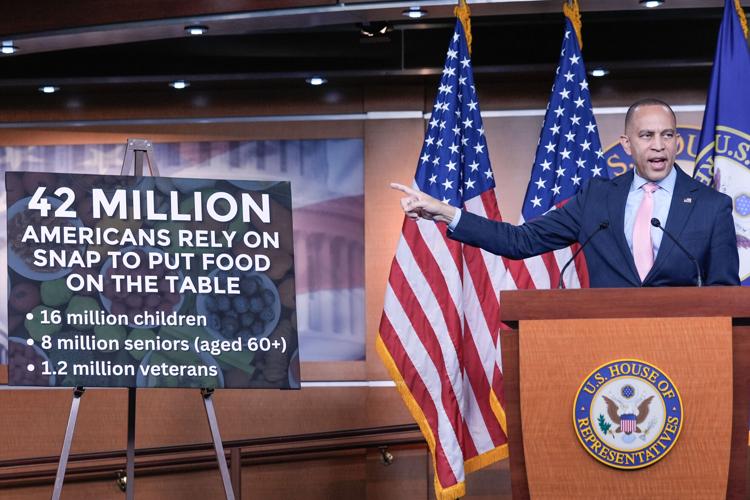
In addition, much of the discussion surrounding the shutdown relates the Supplemental Nutrition Assistance Program (SNAP), commonly known as “food stamps.” SNAP benefits provide food assistance to low- or no-income individuals. According to the USDA Economic Research Service, SNAP accounted for 70 percent of USDA food assistance in FY2024. Over 42 million Americans rely on these benefits, according to USA Today, meaning that a lapse in appropriations may well put their physical wellbeing at risk. A federal judge recently ordered the government to use emergency funding to keep the program afloat, but the Trump administration has argued that it is legally precluded from doing so.
Healthcare is also a major point of contention. Democrats have been holding out throughout the shutdown for an extension to subsidies under the Affordable Care Act, or Obamacare, which provides health insurance to those who otherwise would not receive it. The One Big Beautiful Bill Act passed earlier in 2025 enacted further cuts to welfare, which would become a major political standoff that contributed to the shutdown.
Elected officials from both sides of the aisle have taken this as an opportunity for political clout. On Oct. 26, House Minority Leader Hakeem Jeffries appeared on Face the Nation, where he stated that Democrats were willing to “sit down anytime, any place, with anyone…to reopen the government to negotiate a bipartisan spending agreement that actually meets the needs of the American people.” Republicans, however, are pushing for temporary legislation to fund the government for a time while a longer-term solution is explored. The gridlock that is at the heart of the shutdown, however, will not make this easy. Although Republicans control both houses of Congress, they also “need at least seven Democratic votes to pass any spending bill out of the Senate,” according to Reuters.
As the shutdown drags on, it is difficult to say when exactly it will end. As both parties are presently holding firm to their demands in return for a spending bill, it is likely that some degree of compromise will be necessary to end the ordeal and restore the government to its full functionality. In the meantime, however, the situation is hitting close to home for many Americans, and it is clear that something must be done, and done soon, to prevent further crisis.